Colorimetric Drink Tests: How They Work, Uses, and Limitations
How does the colorimetric reaction work?
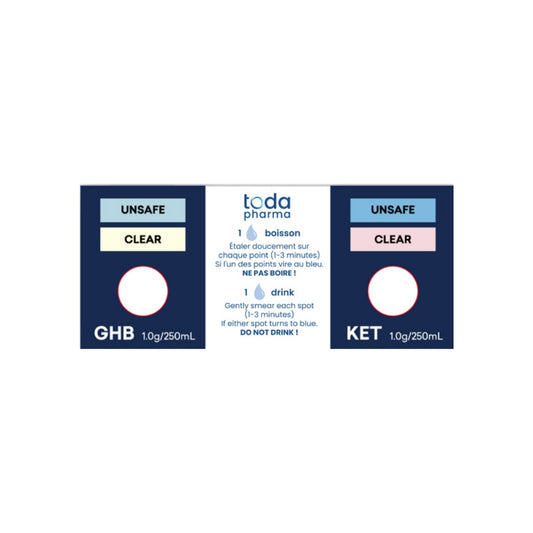
A small amount of drink is placed on an area containing reagents. When the targeted substance is present at a sufficient concentration, a color or appearance change may occur.
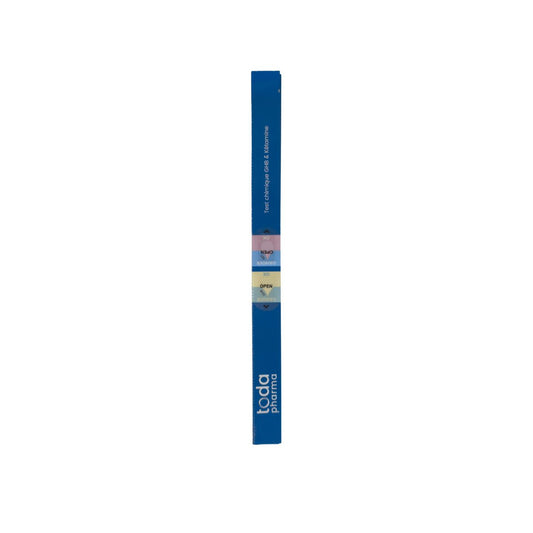
The principle can be integrated into a card, bracelet, or other medium. Each area has its own purpose and must be used according to the instructions.
What factors influence the result?
- The targeted substance: a molecule not included in the panel will not be detected;
- The concentration: too low an amount may remain below the reaction threshold;
- The composition of the drink: color, acidity, sugar, alcohol, or other components can interfere with the reading;
- The volume applied: too much or too little liquid can alter the result;
- The reading time: an observation that is too early or too late is not interpretable;
- The lighting: insufficient or colored light can distort visual assessment.
Positive, negative, or doubtful result
Positive reaction
The area reacted according to the signal described in the instructions. The drink should not be consumed. Keep it if it can be done safely and report the situation to the establishment or law enforcement.
Negative reaction
The target was not detected under the test conditions. This does not prove the absence of any substance and does not make the drink safe.
Doubtful result
An ambiguous color, a highly pigmented drink, a saturated area, or reading outside the time frame should lead to considering the test as uninterpretable.
Main limitations
- Panel limited to certain substances;
- Risk of false negatives or reactions difficult to interpret;
- No complete toxicological identification;
- No equivalent value to a laboratory analysis;
- No information on prior exposure in the body;
- No guarantee against chemical violence or vulnerability.
What to do if someone shows symptoms?
The drink test becomes secondary. Sudden drowsiness, confusion, repeated vomiting, convulsions, loss of consciousness, or abnormal breathing require securing the person and, depending on severity, immediate call to 15 or 112.
Do not leave the person alone, do not induce vomiting, and do not delay medical consultation to finish a test.
Keep useful items
When possible, keep the drink, its container, the test packaging, and a photo of the result taken within the prescribed reading time. Note the time, symptoms, and known consumption.
These elements can guide professionals but do not replace biological samples and toxicological analysis performed in an appropriate setting.
A complementary role in prevention
Colorimetric tests are especially useful as awareness and guidance tools, provided their limitations are clearly explained. They should be part of a system including staff training, reporting points, emergency protocols, and support.
See prevention toolsPrepare an event action