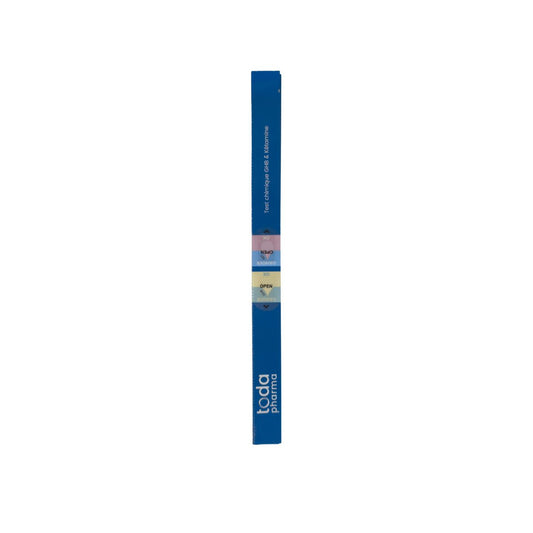
Test Ton Verre® anti-GHB and Ketamine bracelets and cards: the discreet and powerful weapon against date rape drugs
Chemical submission is a major prevention issue in festive settings. To help individuals, associations, bars, clubs, communities, and event organizers take concrete action, AMA Prévention offers Test Ton Verre® devices: bracelets and cards capable of testing a drink to detect the potential presence of GHB or ketamine.
Important: a GHB/Ketamine bracelet or card never replaces collective vigilance, monitoring drinks, mutual support among friends, security team training, or calling emergency services in case of distress. These devices are complementary prevention tools designed to reduce risks and open dialogue about chemical submission.
Chemical submission: what are we talking about?
Chemical submission refers to administering a psychoactive substance to a person without their knowledge or under coercion to make them vulnerable. It can be used to facilitate assault, theft, violence, or sexual offenses. Chemical vulnerability also refers to situations where a person who has voluntarily consumed alcohol, medication, or drugs becomes more vulnerable to assault.
A risk in festive environments
Private parties, bars, clubs, festivals, student events, and festive gatherings are contexts where vigilance must be heightened. A drink left unattended or offered by a stranger can become a risk factor.
GHB and ketamine are not the only substances
GHB and ketamine are often mentioned, but they are not the only substances that can be involved. Sedative medications, benzodiazepines, antihistamines, opioids, MDMA, cocaine, 3-MMC, and other psychoactive substances can also be used in some cases.
The victim is never responsible
A prevention tool should never place responsibility on the victims. It complements a comprehensive strategy: prevention, training, collective vigilance, securing venues, listening, and appropriate support.
Test Ton Verre® bracelet or card: what’s the difference?
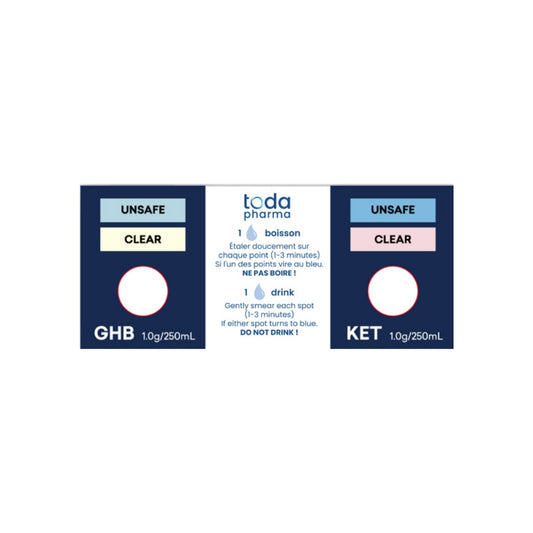
Test Ton Verre® bracelets and cards use the same principle: a reactive tablet allows testing a drink by placing a drop on the designated area. The main difference lies in usage, visibility, and distribution method.
Test Ton Verre® Bracelet
The bracelet is worn on the wrist. It is visible, immediately accessible, and can have a deterrent effect in a festive context. It is particularly suitable for festivals, student parties, bars, clubs, prevention campaigns, and distributions at event entrances.
- Visible and directly accessible
- Ideal for events, festivals, and nightlife venues
- Customization possible from 500 bracelets
- Easy-to-distribute prevention support
Test Ton Verre® Card
The card easily slips into a wallet, pocket, bag, or phone case. It is discreet, practical to carry, and particularly relevant for individuals, travelers, students, associations, bars, or organizers wishing to distribute a compact support.
- Practical and discreet card format
- Easy to keep in a wallet or phone case
- Very suitable for prevention kits and targeted distributions
- Not customizable, but easy to deploy quickly
Remember: the bracelet is the best choice when you want a visible, wrist-worn, and customizable solution for an event. The card is the best choice when you want a discreet, compact format that is easy to carry.
How does the Test Ton Verre® device work?
The operation is simple: the reactive tablet integrated into the bracelet or card allows testing a drink. Just remove the protective sticker, place a drop of drink on the tablet, then observe the color reaction.
1. Remove the protection
Each tablet is protected by an individual sticker to prevent accidental contamination or contact before use.
2. Place a drop
A small drop of drink is enough. The test can be performed on an alcoholic or non-alcoholic drink when in doubt or before consumption.
3. Observe the result
In case of potential presence of GHB or ketamine, a blue color reaction may appear on the tablet within about 1 to 3 minutes.
French manufacturing, CE standard and ISO 13485 quality
Test Ton Verre® bracelets and cards distributed by AMA Prévention are developed and manufactured in France by the Toda Pharma laboratory, a recognized French laboratory in rapid diagnostics. They benefit from controlled manufacturing, traceability, and a quality positioning suited to prevention actions.
Highlighted guarantees
- French manufacturing by Toda Pharma laboratory
- CE Standard
- ISO 13485 Certification
- Cœur Alsace Label
- UAF Label — Used by the French Army
- Tablets protected by individual sticker
Declared performance
Test Ton Verre® tablets show a declared sensitivity of 94% for GHB and 90% for ketamine. However, no rapid test can guarantee absolute protection: a negative result should never lead to lowered vigilance.
Beware of unverified products: the market contains many items presented as “anti-GHB” without clear traceability, precise technical information, or serious validation. For credible prevention, it is essential to choose a device that is identified, documented, and distributed by a reliable actor.
What do Test Ton Verre® bracelets and cards detect? What are their limits?
Test Ton Verre® bracelets and cards are designed to detect the potential presence of GHB or ketamine in a drink. They do not detect all substances that may be involved in chemical submission or chemical vulnerability.
What the device targets
- GHB, also called gamma-hydroxybutyric acid
- Ketamine
- Potential presence in a tested drink
- Visual reaction by color change
What should not be promised
- It does not detect all drugs
- It does not replace toxicological analysis
- It does not guarantee that a drink is “safe”
- It does not replace calling for help in case of illness
- It must not create a false sense of security
Responsible formulation: a negative test only means that the device did not react to the targeted substances under the conditions of use. It does not guarantee the absence of any psychoactive substance or the absence of risk.
Who and in what contexts should Test Ton Verre® be used?
Test Ton Verre® bracelets and cards are designed for both individuals and professionals or organizations that want to implement visible, concrete, and responsible prevention against chemical submission.
Individuals
- Nights out at bars, clubs, or private parties
- Festivals, concerts, and trips
- Students and young adults
- People wanting to keep a discreet prevention tool
Events and festivals
- Distribution at the entrance or at a prevention booth
- Awareness actions with the public
- Strengthening the event’s responsible image
- Complement to security teams and listening points
Bars, clubs, and communities
- Availability at the bar or reception
- Prevention in nightlife venues
- Local campaigns against violence
- Distribution by associations, student unions, town halls, or youth services
Overall prevention: bracelets and cards should ideally be combined with clear messages: do not leave your glass unattended, stay in groups, alert quickly if in doubt, train teams, and plan a support protocol for victims.
Instructions: testing a drink with a card or bracelet
Use should remain simple, clear, and quick. To avoid errors, it is recommended to read the instructions provided with the product before any distribution or use in the field.
Usage steps
- Store the device properly before use
- Remove the protective sticker from the pad
- Place a drop of the drink on the reactive area
- Wait the time indicated in the instructions
- Observe the color of the pad
- Never consume the drink if in doubt or if there is a suspicious reaction
Best practices
- Use a new pad for each test
- Do not touch the reactive area with fingers
- Do not wet the test pad before testing
- Respect the expiration date
- Store at room temperature, away from humidity
- Plan a clear procedure in case of a positive reaction
Pricing, volume, customization: choose the right format
AMA Prévention offers Test Ton Verre® devices in packs suitable for individuals, associations, establishments, communities, and event organizers. Cards are practical for discreet and quick distribution. Bracelets are especially suited for visible actions at festivals or parties.
Test Ton Verre® Cards
Cards are available in packs of 10. They are easy to store, distribute, and carry. Their compact size allows them to fit in a wallet, bag, pocket, or phone case.
Important: Test Ton Verre® cards are not customizable.
Order the cardsTest Ton Verre® Bracelets
Bracelets are available in packs of 10 and can be deployed in volume for events. They can be customized from 500 bracelets with a logo, color, or prevention message.
Customization: available only for bracelets, starting from 500 units.
Order the braceletsFor event orders: organizers, communities, associations, BDEs, bars, clubs, and festivals can request a quote to anticipate volumes, deadlines, logistics, and associated prevention materials.
What to do in case of a positive test, doubt, or malaise?
The most important thing is not to minimize the situation. In case of a suspicious reaction, malaise, memory loss, or unusual behavior, act quickly, protect the person, and seek help.
If the test reacts
- Do not consume the drink
- Move away from the person or suspicious context
- Immediately inform your relatives or security staff
- Keep the glass if possible, without putting yourself in danger
- Report the situation to the venue or event manager
If someone shows symptoms
- Never leave them alone
- Call 15, 18, or 112 in case of malaise, confusion, or loss of consciousness
- Do not force them to drink, eat, or vomit
- Keep useful items: glass, bottle, messages, testimonies
- Refer them to medical care and specialized support
Essential reminder
In case of suspected chemical submission or assault, the victim is never responsible. Priorities are safety, listening, emergency care, preserving useful evidence, and support.
Why include bracelets and cards in a real prevention strategy?
Distributing a bracelet or card is not enough if the device is not accompanied by a clear message. The best results come when these tools are part of a comprehensive approach: public information, signage, team training, alert protocol, listening points, and referral to emergency services.
Raise awareness
The cards and bracelets help start a concrete discussion about the risks of chemical submission without dramatizing or blaming victims.
Deter
A visible device, especially the bracelet, can send a clear signal: the event takes prevention seriously and the public has tools to respond.
Protect
Test Ton Verre® devices give the public an additional way to check a drink and ask for help if in doubt.
Equip your parties, festivals, or prevention campaigns
AMA Prévention supports individuals, associations, communities, bars, clubs, venues, BDEs, and event organizers with concrete solutions against chemical submission: Test Ton Verre® bracelets, Test Ton Verre® cards, glass condoms, screening tests, and prevention tools.
Frequently asked questions about anti-GHB bracelets and cards
What is the difference between the Test Ton Verre® bracelet and card?
The bracelet is worn on the wrist: it is visible, accessible, and customizable from 500 units. The card is more discreet: it fits in a wallet, pocket, or phone case. Both formats are used to test a drink with a reactive tablet.
Are Test Ton Verre® cards customizable?
No. Test Ton Verre® cards are not customizable. Customization is available for bracelets starting at 500 units.
Are Test Ton Verre® bracelets customizable?
Yes. Bracelets can be customized from 500 units with a logo, color, or prevention message. This option is especially suitable for festivals, communities, BDE, associations, and event organizers.
Does the device detect all drugs?
No. Test Ton Verre® bracelets and cards target GHB and ketamine. They do not detect all substances that may be involved in chemical submission, such as certain medications, benzodiazepines, sedatives, antihistamines, opioids, or other drugs.
Does a negative test guarantee a drink is safe?
No. A negative test does not guarantee the absence of danger. It only means the device did not react to the targeted substances under the usage conditions. When in doubt, do not consume the drink.
How long does it take to get a result?
The color reaction can appear within 1 to 3 minutes if GHB or ketamine is potentially present, depending on the usage conditions and the tested drink. Always follow the instructions provided with the product.
Who are these devices for?
They are intended for individuals, students, travelers, associations, bars, clubs, discos, festivals, communities, BDE, schools or universities, event organizers, and organizations involved in preventing violence and chemical submission.
What to do if a drink seems suspicious?
Do not consume it. Warn your loved ones, security staff, or the person in charge of the venue. If someone shows unusual symptoms, do not leave them alone and call emergency services: 15, 18, or 112.
Conclusion: anti-GHB bracelet and card, two complementary formats
Test Ton Verre® bracelets and cards are not gadgets. They are concrete prevention tools designed to help test a drink in case of doubt and strengthen collective vigilance against chemical submission.
The bracelet is ideal for events, festivals, and visible actions, especially when customization is desired. The card is perfect for discreet, compact prevention, easy to carry daily. Together, these two formats allow prevention to adapt to real-world uses.
By choosing Test Ton Verre®, individuals, professionals, and organizers support a French, responsible, and committed approach against chemical submission, always remembering the essential: safety relies on prevention, mutual aid, vigilance, and rapid victim care.
Sources and useful resources
- Stop the violence — Chemical submission and chemical vulnerability
- ANSM — National surveys on chemical submission and addictovigilance
- National Gendarmerie — Chemical submission, a public health issue
- AMA Prévention — Pack of 10 Test Ton Verre® anti-GHB/ketamine cards
- AMA Prévention — Pack of 10 Test Ton Verre® anti-GHB/ketamine bracelets
Which substances can be detected in a drink?
Chemical submission is not limited to GHB. Reported cases may involve sedatives, anxiolytics, antihistamines, opioids, or drug mixtures. This is precisely why a modern prevention approach must address drugs in drinks, not just anti-GHB.
Type 1 benzodiazepines
The “-pam” family: diazepam/Valium, oxazepam/Séresta, lormetazepam, bromazepam/Lexomil, clonazepam/Rivotril, lorazepam, flunitrazepam, nordazepam, loprazolam/Havlane, chlorazepate/Tranxène, prazepam/Lysanxia, nitrazepam, temazepam, chlordiazepoxide. Noted exception: clobazam.
Type 2 benzodiazepines
The “-lam” family: alprazolam/Xanax, midazolam, triazolam, estazolam and related molecules.
Synthetic benzodiazepines
Bromazolam, etizolam, bentazepam, bromonordiazepam/desalkylgidazepam, flubrotizolam, fluclotizolam, gidazepam, methylclonazepam, norflurazepam/desalkylflurazepam, thionordazepam/demethylsulazepam, tofisopam/Emandaxin.
Other relevant families
Antihistamines and phenothiazines: pheniramine/Fervex, cyamemazine, alimemazine/Théralène, levomepromazine/Nozinan, chlorpromazine/Largactil, promethazine. Opioids: codeine, morphine, oxycodone and related opioids, with caution regarding pure tramadol. Other substances: GHB, ecstasy/MDMA, and certain cutting drugs.
Important note: this information should be read as an aid to prevention and choosing risk reduction tools. A drink test does not replace collective vigilance, medical care, or sampling conducted in a medico-legal context. Antipsychotics such as olanzapine, clozapine, or quetiapine are mentioned as a family to be confirmed.
Prevention FAQ: drink tests, GHB, and chemical submission
Is an anti-GHB product enough to cover the risk?
No. GHB is highly publicized, but chemical submission can also involve benzodiazepines, sedative antihistamines, opioids, ecstasy/MDMA, or mixtures. A prevention strategy must therefore address drug detection in drinks more broadly.
Why combine B-SAFE with Test Ton Verre bracelets or cards?
Uses differ: cards and bracelets are simple, accessible, and suited for event distribution; B-SAFE offers a broader, premium approach for individuals, venues, or organizers who want to strengthen control over a suspicious drink.
What to do in case of discomfort or doubt?
Ensure the person’s safety, do not leave them alone, alert those around or staff, contact emergency services if necessary, and keep the glass if analysis might be useful. The test is a prevention tool, not a medical diagnosis.
Scientific validation of B-SAFE
The B-SAFE project, a drug detector pen for drinks, is validated and supported by Professor Jean-Claude Alvarez, toxicologist, professor of pharmacology-toxicology, and director of the toxicology laboratory at CHU Raymond-Poincaré/AP-HP in Garches.
A leading authority in toxicology, he is associated with the reference work conducted in France on psychoactive substances and chemical submission, in a national ecosystem also supported in public debate by voices such as Sandrine Josso and Caroline Darian.
This validation strengthens B-SAFE's technological positioning and the accuracy of its detection for drug prevention in drinks. Discover the B-SAFE product sheet.
2 comments
Waouuu! Un très grand merci a Toda pharma et a Ama prévention. Voilà des gens biens, de belles personnes qui prennent soin de nos femmes et jeunes filles et ados. Il ne reste plus qu’à inventer le produit pour soigner radicalement ces monstres, prédateurs.
Encore bravo à toutes ces personnes pour leur travail et leur conscience de vrai être humain pour un monde meilleur.
Daniel.
Prévenir et protéger nos petits enfants.